Third Wave Coffee Movement
Special bonus! I try to explain Third Wave Coffee even though I’m not an expert.
Written by Kevin Whalen
You may hear about “Third Wave” - it treats coffee more like other gourmet artisan food items especially like wine. The coffee beans are given the same kind of attention that wine grapes receive. This is more in the specialty coffee arena and not so much in the pure coffee as a commodity world, but even the largest coffee suppliers have taken notice of some of these concepts.
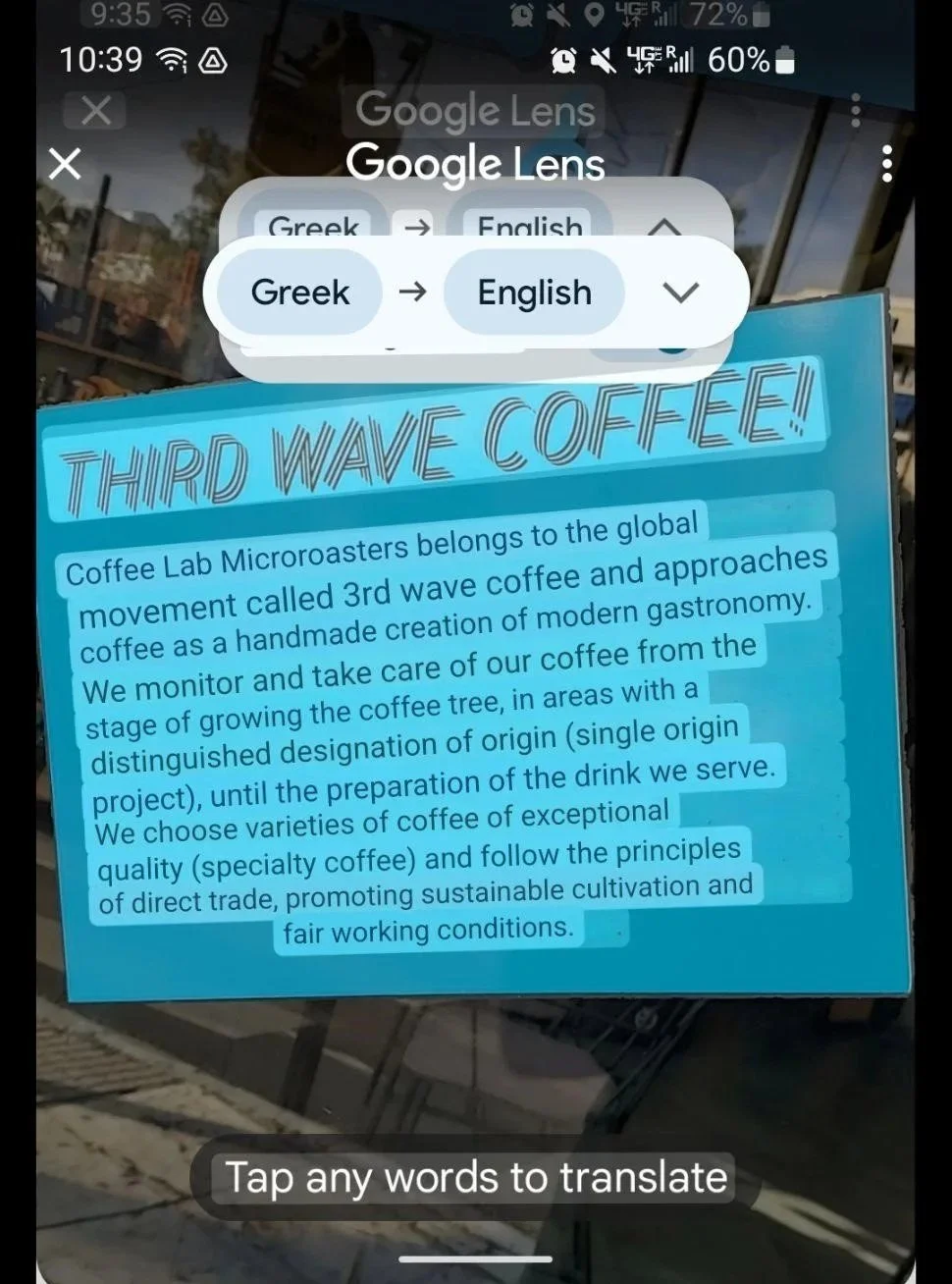
I first saw the phrase, “Third Wave Coffee” in an Athens, Greece, coffee shop a few years ago. The sign was in Greek, but I think Google Translate does it justice.
The coffee “waves” are focused on modern coffee experiences, especially on how capitalism, mass production, and marketing have changed the industry. For that reason, the waves only cover from about the Age of Enlightenment to the present, even though coffee consumption was happening many centuries before colonialism.
By the way, the term “Third Wave” and additional descriptions was coined by a barista, roaster, coffee quality evaluator, and coffee shop owner named Trish Rothgeb in 2002. Her view was that the first and second waves of coffee failed to provide consistent high-quality coffee experiences, and so here we are.
Roughly speaking, the three waves (so far) are:
● First Wave – at the end of coffee becoming popular during the Enlightenment, the First Wave was about commoditizing coffee and building mass consumption. First Wave brought the emergence of pre-ground, shelf stable coffee (1800s to maybe 1960s). Note that there was coffee long before these coffee waves
● Second Wave -known for coffee shops that offered much more than brewed coffee and included more espresso-based drinks, more specialty coffee drinks. Second Wave brought us Starbucks and all the other coffee houses that took off during this time (1970s to early 2000s).
● Third Wave - focused on the specific coffee, including where it came from, who grew it, how it was roasted (not just how light or dark but times and temperatures to bring out the best flavors in different beans). Third Wave also features how coffee was made. There are constant innovations in brew technology – many of us have made espresso, filter/drip, pour over, French press, but there are also Chemex, AeroPress, Delter, moka pot, cold brew, on and on, and variations and improvements on each of those. (Side note, no, I don’t own all these, but I do like espresso and I like my AeroPress.) There are varying definitions, but you’ll generally see “Third Wave” as referring to:
● traceability - usually more than which region, Third Wave can identify which farmer, and sometimes, which plot of land on a particular farmer’s land;
● lighter roasts – intended to highlight the flavor of the coffee bean and maintain complex flavors that may get roasted out in darker roasts. 2nd wave brought more dark roasts, which is why Starbucks was sometimes referred to as Charbucks;
● brewing precision – some examples include:
measuring grounds and water to the gram (the “golden ratio” is generally 1 gram of coffee to 15-18 grams of water by weight)
thermometers for water temps (depending on preparation method, water should be anywhere from 160-to 200; for steamed milk, the temp should be 130F-150F
gooseneck kettles to control the pour over, provide more even coffee extraction, better “bloom” control at the very beginning - seriously, people experiment with this, use robotics to test pour overs, on and on to keep finding better ways to do this . . . in the end, remember - there’s no one right way to brew coffee, there’s only what’s right for you.
● sustainability - that means more organic-certified coffees (like our Farmer to Farmer coffee) and paying farmers better while improving working conditions (also like Farmer to Farmer).
Fourth Wave?
But wait . . . . there’s more! There is some debate about whether we’re actually already in the Fourth Wave of coffee or whether this is the Third Wave continuing to evolve. Fourth Wavers say this continues the technology, traceability, and sustainability of the Third Wave, but Fourth Wavers say it’s more than that:
● Now the Third Wave technological precision is available at home, whether as a barista, a roaster, or even as a small direct green importer.
○ In my own experience, for example, a decade ago, there was no affordable,
compact espresso machine that made good espresso (by my standards, anyway
- and when I first fired up my little Breville Bambino Plus, it was immediately
apparent that the “espresso” I had previously been making from my electronics
store espresso machine was not really espresso at all - and keep in mind, in the
coffee world, I have what’s considered an entry level model, which is probably as
much as I’ll ever want).
○ Some coffee producers (farmers and co-ops) are now offering direct-to-consumer
sales, which would have been a cost-prohibitive importing nightmare without
today’s technology
● Technology is driving increasingly complex coffee research from the botanical to the AI-driven flavor predictors
● Fourth Wave brings high quality ready-to-drink options, as you see stores with many different varities of pre-packaged coffee beverages (even coffee martinis).
● we’re also seeing more direct storytelling about producers, where Farmer to Farmer has always been ahead of the curve because these are our partners and our friends.
○ For some perspective, it wasn’t that long ago that Juan Valdez, a fictional advertising character created by a New York ad agency for the Colombian coffee industry was really Americans’ only exposure, such as it was, to coffee farmers (by the way, there are coffee shops in Colombia called Juan Valdez, and these are owned by the federation representing hundreds of thousands of Colombian farmers, so at least the actual farmers can theoretically benefit from the brand).
● coupled with the storytelling and acknowledging the challenges farmers experience, the Fourth Wave is trying to level the playing field so that the farmers aren’t saddled with most of the risks (weather, climate, currency exchange rates, crop failures, etc.) while getting the smallest payout along the entire supply chain (the deck is stacked against the farmers, especially the smallest farmers, but that’s a discussion for another day) Discussing the coffee waves is a way to explain the evolution of coffee and provide context for what you see in stores, shops, and online. People devote their lives to studying some of the most minute details of coffee, from planting and growing, processing, roasting, and brewing. But whichever coffee wave we’re in, it still comes down to what each person likes or doesn’t like.
Enjoy!